ERP · Quickplus
Government Services ERP
From ticket to ledger.
An ERP for walk-in government-service centres in Dubai, from the reception ticket to the cashier, the back office and a double-entry ledger.
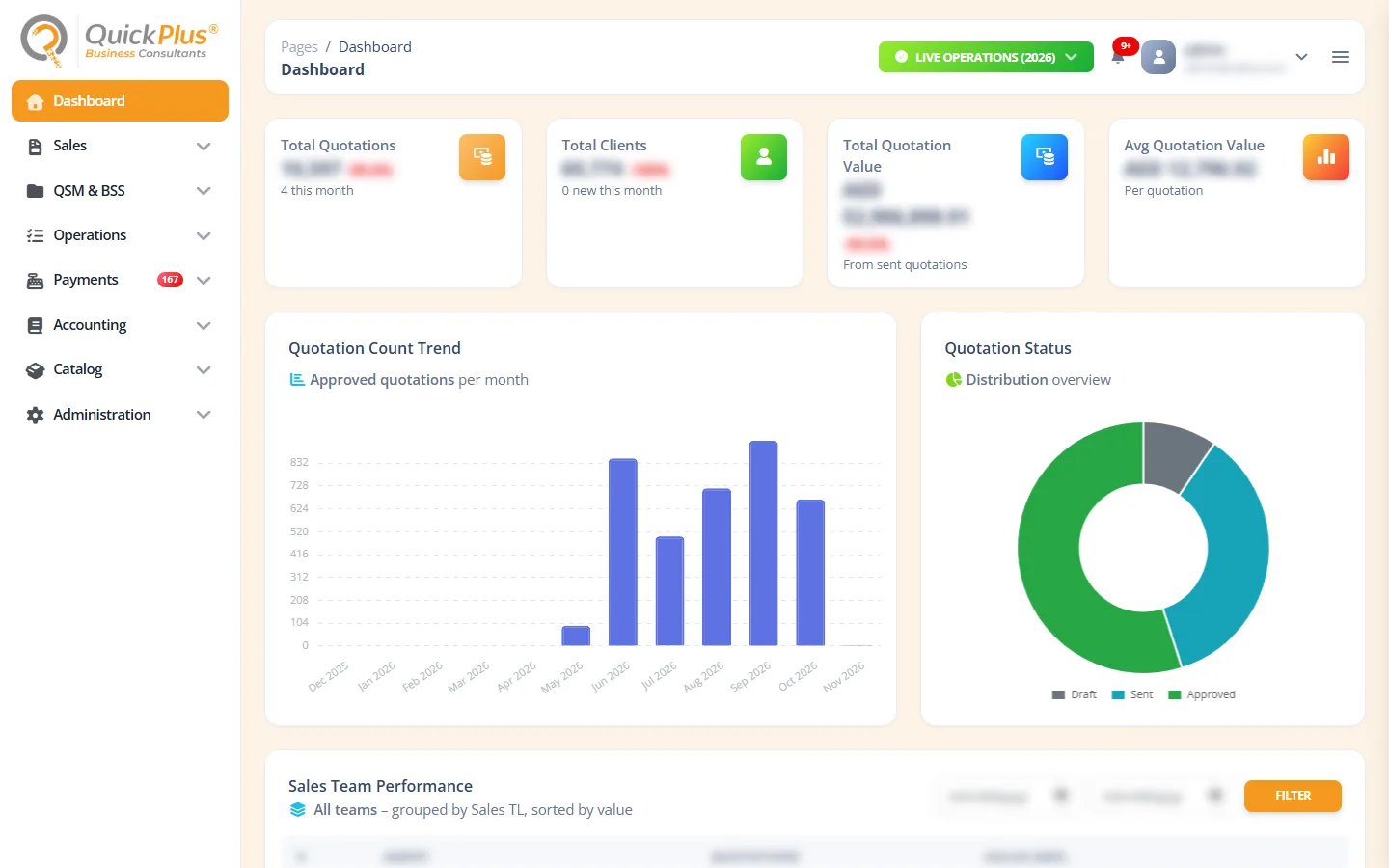
Client data blurred
Role
Main contributor in a five-developer team (architecture, accounting engine, data migration, DevOps)
Period
Jan 2026 – Present
Team
5 developers
Stack
- PHP
- Laravel
- MySQL
- Bootstrap
- JavaScript
- Docker
- nginx
- PHPUnit
- Google Drive API
Highlights
What stands out.
Four-station workflow
Reception, consultant, cashier and back office, with stages that can be skipped by service type.
Double-entry accounting
Vouchers, a general ledger and client statements, with reversal-only corrections.
Four-tier commissions
Rates resolved per agent and service, stamped on each ticket line and paid out with invoices.
Legacy migration
An ETL suite that moved years of data from the previous system and repaired broken Arabic text.
The problem
Walk-in centres that process residency, labour, medical-fitness, ID and economic-department transactions were running on an older system. The business needed one ERP that runs the whole floor, from the reception ticket to the cashier and the back-office typists, and posts every payment to a correct double-entry ledger, in English and Arabic.
What I built
- Four-station ticket workflow. Reception intake, consultant review, cashier settlement and back-office processing. Some service types skip consultant review.
- Service-based access control. Each ticket belongs to one service type, and users only see the types their permissions allow.
- Service fee engine. Five price components per service (government fee, bank fee, typing, staff commission, service fee), with VAT switched on per component.
- Cashier desk and shifts. Full, partial and instalment payments, card and buy-now-pay-later surcharges, and a shift lifecycle of open, close and supervisor approval.
- Double-entry accounting. Chart of accounts with an audit log, general, receipt and payment vouchers, a general ledger, client statements and per-service GL account mappings.
- Four-tier commission engine. Rates resolve from agent and service down to common service rates; commission is stamped on the ticket line and paid out with an invoice PDF.
- Government e-wallet. Wallet top-ups, reconciliation and a backfill of legacy journals.
- Reports. Itemised P&L, trial balance, client statement, cashier ledger, unpaid invoices and commission analytics.
- Public document links. Rate-limited, UUID-addressed invoices, receipts and vouchers as bilingual PDFs.
My role
I was the main contributor in a team of five: I worked on the architecture and the accounting engine, built the data migration, and set up the Docker deployment and server tuning.
Engineering highlights
- Accounting correctness. Reversal-only corrections, P&L accounts excluded from the trial balance, credit-normal sign handling and repair commands for duplicate vouchers.
- Performance under office load. Ticket search moved to indexed lookups; PHP-FPM, OPcache and nginx tuned for many counter staff at once.
- Documented engineering. Implementation plans, deep-dive reports and a system manual live with the code.
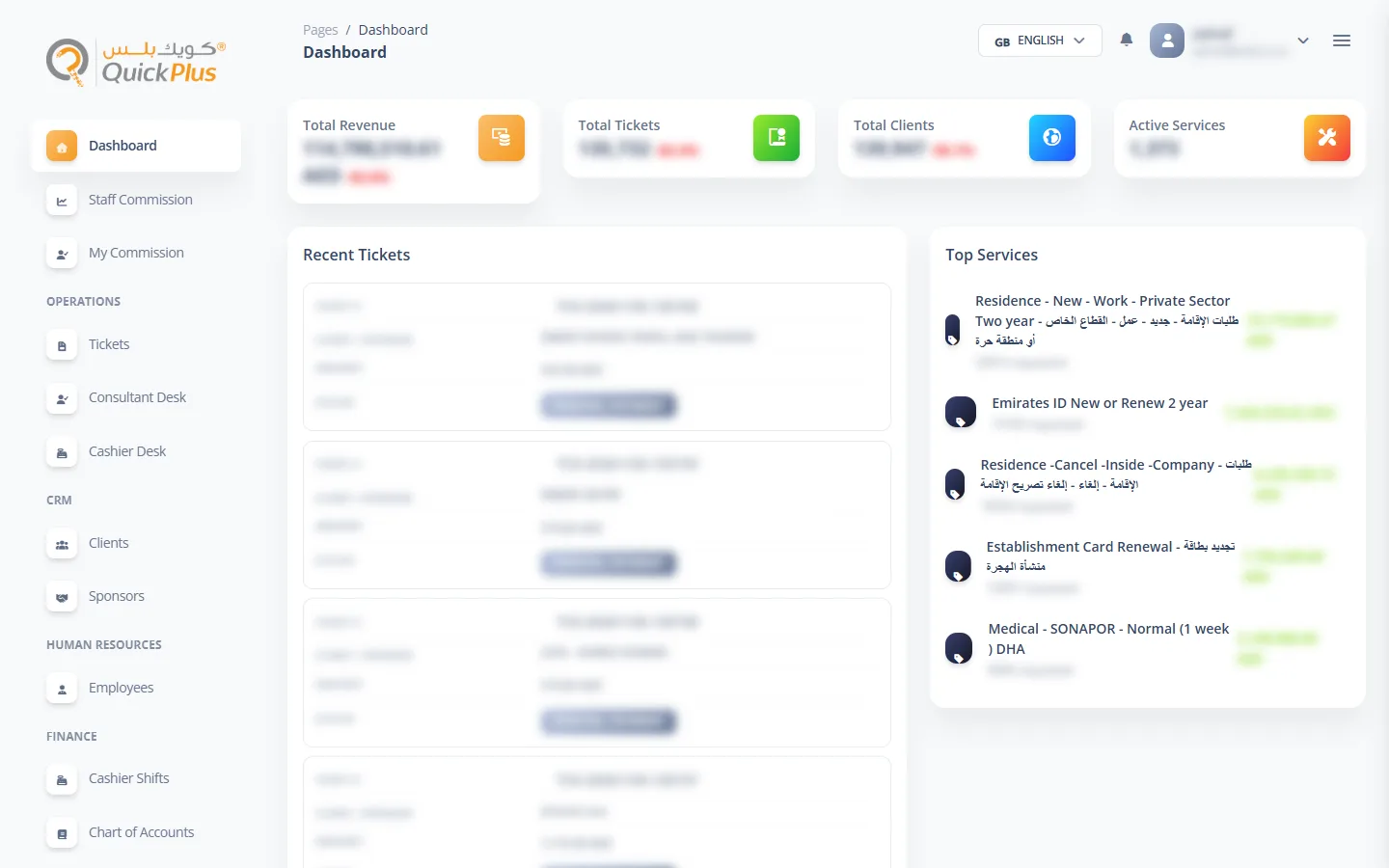
Dashboard: KPIs, recent tickets and top services
How it fits together
The architecture.
A Laravel 11 application with a service layer: workflow, pricing, cashier shifts, commissions and accounting are separate services. Every payment goes through the accounting service, which resolves the right GL accounts for the service type and writes balanced debit and credit lines.
Results
By the numbers.
Tech specs
What it’s built with.
- Backend
- PHP 8.2, Laravel 11, service layer, Artisan commands, scheduler
- Access
- Session auth, Spatie Laravel Permission, Sanctum
- Database
- MySQL 8 (InnoDB, utf8mb4), 250+ migrations
- Documents
- mPDF (English and Arabic), Excel exports
- Frontend
- Blade, Bootstrap 5, Laravel Mix
- Testing
- PHPUnit, around 100 test classes
- DevOps
- Docker and Compose, nginx, PHP-FPM and OPcache tuning, scripted zero-downtime deploys