ERP · Quickplus
Business-Setup ERP
Quotation to cash, in one system.
An ERP for a UAE business-setup consultancy, from quotation to task fulfilment to cash collection, posted to double-entry accounting.
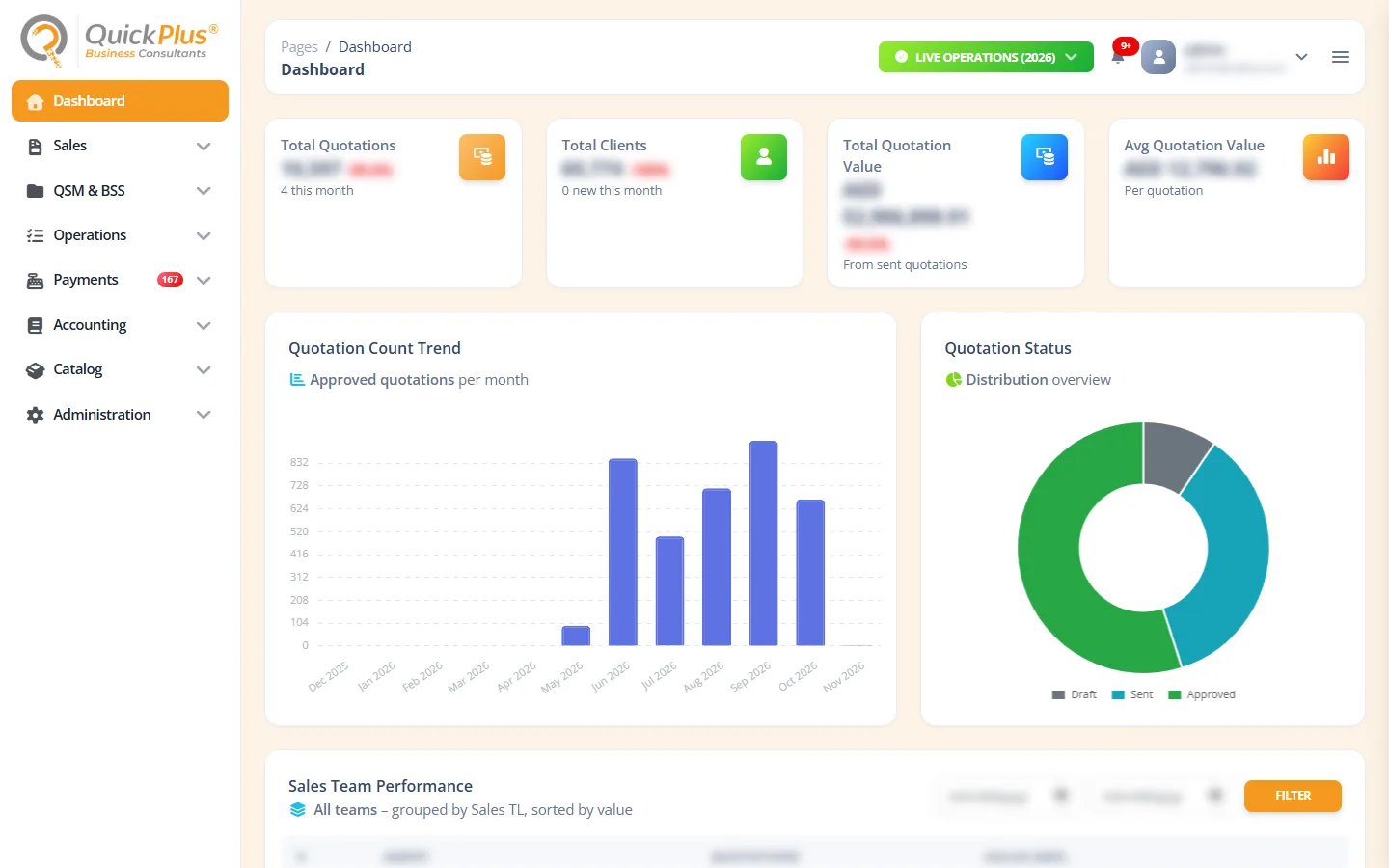
Client data blurred
Role
Lead contributor in a five-developer team (pricing engine, quotations, task workflow, finance, data migration)
Period
Jan 2026 – Present
Team
5 developers
Stack
- PHP
- Laravel
- MySQL
- Bootstrap
- JavaScript
- Google Drive API
Highlights
What stands out.
Pricing held in the database
Packages, activities, visas and rules live in tables, so prices change without a deploy.
Bilingual quotations
A multi-step builder with manager approvals and an English and Arabic PDF.
Tasks with SLA timers
Operations work through subtasks with time limits, documents and a timing log.
Five-stage refunds
Team lead, operations, finance and management sign off before payout.
The problem
A business-setup consultancy sells company formation across mainland and free-zone jurisdictions. Prices depend on the emirate, jurisdiction, package, activities and visas, and every sale turns into a chain of operational tasks and payments. The team needed one system from the first quotation to the final ledger entry.
What I built
- Data-driven pricing. Emirates, jurisdictions, packages, package variants, activities, charge items, add-ons, price lists and pricing rules, all in the database, including visa logic per labour and per investor.
- Quotation builder. A multi-step wizard (client, emirate, jurisdiction, package, variant, activities) with custom lines, manager-approved price changes, status history and a bilingual PDF.
- Renewals and quick services with their own approval flows, quotations, invoices and CSV import.
- Task fulfilment. Agent approval, payment, operations subtasks with time limits and SLA timeouts, then completion, with documents, comments and a PDF report.
- Cashier desk. One workstation to collect cash, card, cheque and bank payments against a task, with surcharges and shifts.
- Five-stage refunds. Team lead, operations, finance, management, then payout, with documents and an audit log.
- Financial accounting. Chart of accounts, receipt, payment and journal vouchers, reversal-only corrections, P&L, trial balance with data-scope filters, and client statements.
- Integrations. A link to the group's recruitment CRM for contract applications and refund sync, and a lookup API for the CRM.
- Pluggable file storage. NAS over SFTP, Google Drive or local disk, chosen at runtime.
My role
I led development of the pricing engine, the quotation builder, the task workflow and the finance module, and built the import of the company's previous ERP history.
Engineering highlights
- Pricing engine refactor. Removed hard-coded package tiers and moved every price into rule tables.
- Legacy ETL. Imported clients, quotations, tasks and statuses from the old ERP, with client de-duplication by email and passport, dry-run mode for opening balances and status mapping for imported tasks.
- Accounting rules. Credit-normal sign logic, a data-scoped trial balance and itemised cash receipts.
- Multi-role safety. Lookups stay correct for users who hold several roles at once.
Sales dashboard
How it fits together
The architecture.
Sales, operations and finance are separate areas of one Laravel application. An accepted quotation becomes a task; the task raises payment requests that the cashier desk settles; every settlement posts to accounting. File storage sits behind one storage manager with several drivers.
Results
By the numbers.
Tech specs
What it’s built with.
- Backend
- PHP 8, Laravel 11, service layer, scheduled commands for SLA timeouts
- Access
- Spatie Laravel Permission v6 (permission-based)
- Database
- MySQL / MariaDB
- Documents
- mPDF 8 (English and Arabic), Excel exports
- Storage
- SFTP NAS, Google Drive API, local disk
- Frontend
- Blade, Bootstrap 5, Laravel Mix