SaaS · Quickplus
EstaBiz
Form a company online.
An AI-assisted company-formation platform for the UAE, with an AI advisor that answers setup questions from the company's own knowledge base.
Role
Lead developer, frontend and backend
Period
May 2026 – Aug 2026
Stack
- Next.js
- React
- TypeScript
- Tailwind CSS
- shadcn/ui
- Laravel
- PHP
- PostgreSQL
- pgvector
- OpenAI API
- Redis
- Clerk
- +7 more
Highlights
What stands out.
Eight-step application
Activities, trade names, shareholders, documents, package and payment in one wizard.
AI advisor with RAG
Streaming answers grounded in the company's own setup and pricing documents.
Gateway-agnostic payments
Stripe, Telr and PayTabs behind one strategy interface.
Independent deploys
The API verifies identity tokens itself, so frontend and backend ship separately.
The problem
Setting up a company in the UAE means choosing activities and trade names, arranging investor shares, uploading passports, picking a package and paying. The business wanted applicants to do all of it online, get answers to their setup questions, and track progress, with an admin portal for the team running the applications.
What I built
- Customer portal. Email one-time-code and Google or Apple sign-in, onboarding, an eight-step application wizard, and a dashboard that tracks the application.
- AI chat assistant. Streaming chat backed by a RAG engine on the API: OpenAI embeddings in PostgreSQL with pgvector, and grounded answers from GPT-4o-mini.
- Payments. A strategy-pattern gateway layer (Stripe, Telr, PayTabs) behind one payment service, with webhooks.
- Documents. Passport and other uploads streamed to the company's NAS over SFTP.
- Notifications. WhatsApp status alerts through Twilio.
- Admin portal. Applications pipeline, document review, statuses, pricing master data, users, roles and metrics.
- Role-based access on both the UI routes and the API middleware.
My role
I was the lead developer on both the Next.js frontend and the Laravel API. I planned and delivered the project in nine documented phases, from setup and design system to admin portal and deployment.
Engineering highlights
- Phased delivery. Setup, design system, landing, auth, onboarding, AI chat, application wizard, admin dashboard, then polish and deploy, each with its own written spec.
- Technology choices on record. A services document explains why each vendor was chosen and lists the alternatives.
- Gateway-agnostic payments. Adding a provider means writing one gateway class.
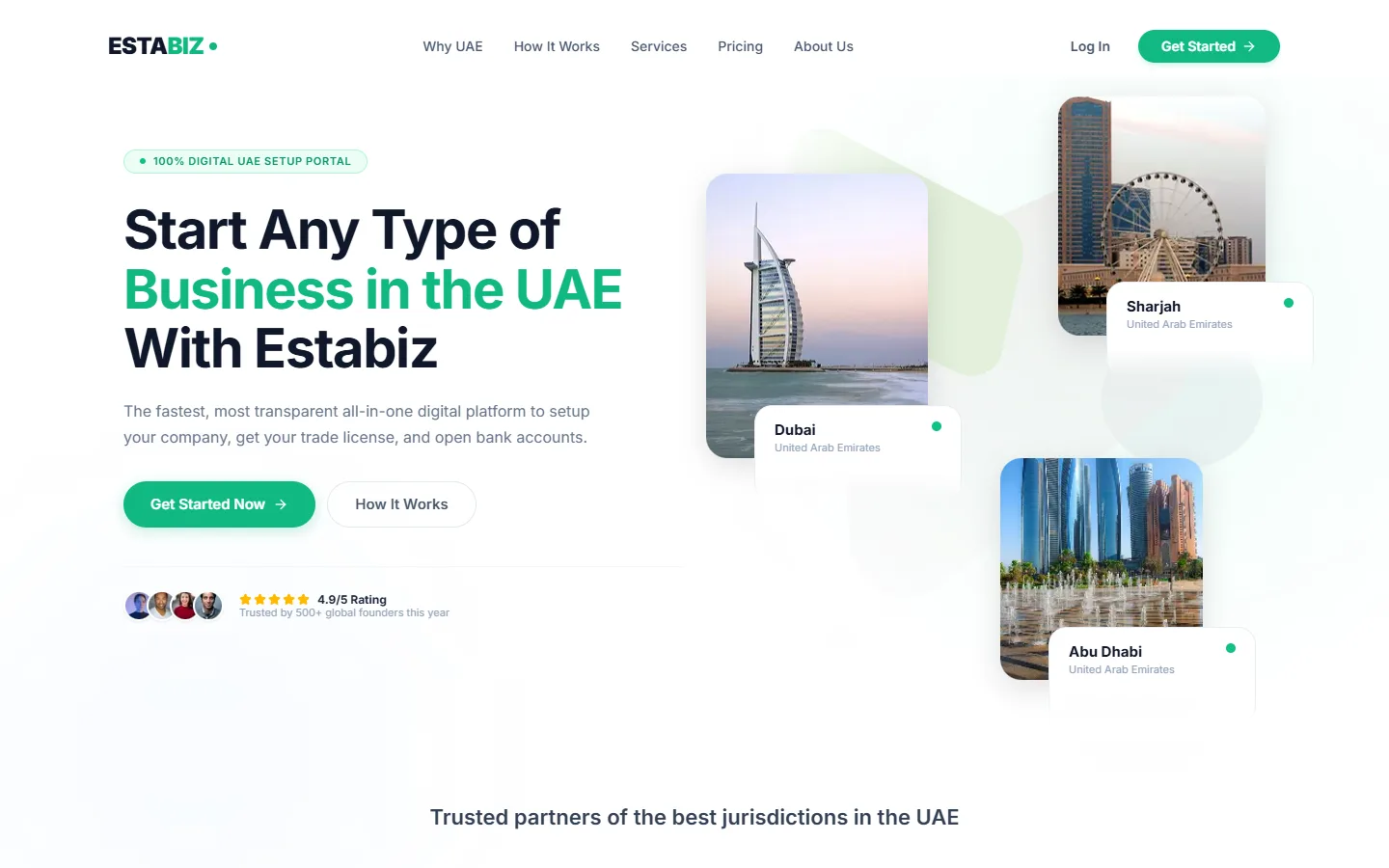
Landing page
How it fits together
The architecture.
A decoupled SaaS: a Next.js 16 frontend talks to a Laravel 11 REST API. Clerk issues identity tokens; the API verifies them against the public key set, so there's no shared session. The chat service embeds the question, finds the closest knowledge chunks in pgvector and streams a grounded answer.
Results
By the numbers.
Tech specs
What it’s built with.
- Frontend
- Next.js 16 (App Router), React 19, TypeScript, Tailwind CSS 4, shadcn/ui, Zustand, React Hook Form + Zod
- Auth
- Clerk (one-time codes, Google and Apple sign-in, JWT verified via JWKS)
- AI
- Vercel AI SDK, OpenAI (GPT-4o-mini, embeddings), pgvector
- Backend
- PHP 8.3, Laravel 11, DomPDF, Flysystem SFTP, Sentry
- Data
- PostgreSQL + pgvector, Redis
- Payments and messaging
- Stripe, Telr, PayTabs; Twilio WhatsApp
- DevOps
- Multi-stage Docker, DigitalOcean + nginx + Let's Encrypt, Vercel previews